The 6 best kept secrets for long-term SUCCESS in the gym to lose body fat and gain muscle!
1. You only need 3 workouts a week for 30-60 minutes
There’s an old saying that you can work long or hard. Strength training is exactly that. Your time is valuable, and wasting an extra 3-6 hours a week takes you away from everything else you have going on. The 80/20 rule is in full effect. 80% of your results come from 20% of your effort. When family, work, and your time are on the line, every hour is valuable. Let’s be honest: not everyone loves working out or even going to the gym, and that's okay. But you know exercise will improve your health, confidence, and energy to allow you to keep up with everything you have going on.
2. Full-body workouts are the most effective way to spend time in the gym.
When your schedule is packed, time is of the essence, and working out has to be as efficient as possible. You need to hit a muscle group so much throughout the week to build muscle and full body allows you to hit that threshold. It also does not leave you debilitated and sore to the point of not being able to function the next day. Which can be common with an individual body part focused training session. You are always welcome to do 4 day if you find time.
Here are a few example schedules that can help you navigate your 3 workouts a week. (You can even find 2- and 4 day a week variations in the mix) This is not the only way to break it up. It’s always good to get a day of rest in between, but if you cannot, that is not a reason not to go.
3. How the best coaches build your full body workout in only 60 seconds
When building your own full-body workout, it is important to hit each muscle group. The main 4 being chest, back, quadriceps, and hamstrings. If you only have 30 minutes in the gym 2-3 times a week, this format will serve you best. If you have more time, add in accessory movements such as arms, calves, shoulders, and/or abs.
Below, I added a chart to help you build your own workouts. You can mix and match the exercises any way you want to. These also are not the only exercises out there, just the best bang for your buck when it comes to time.
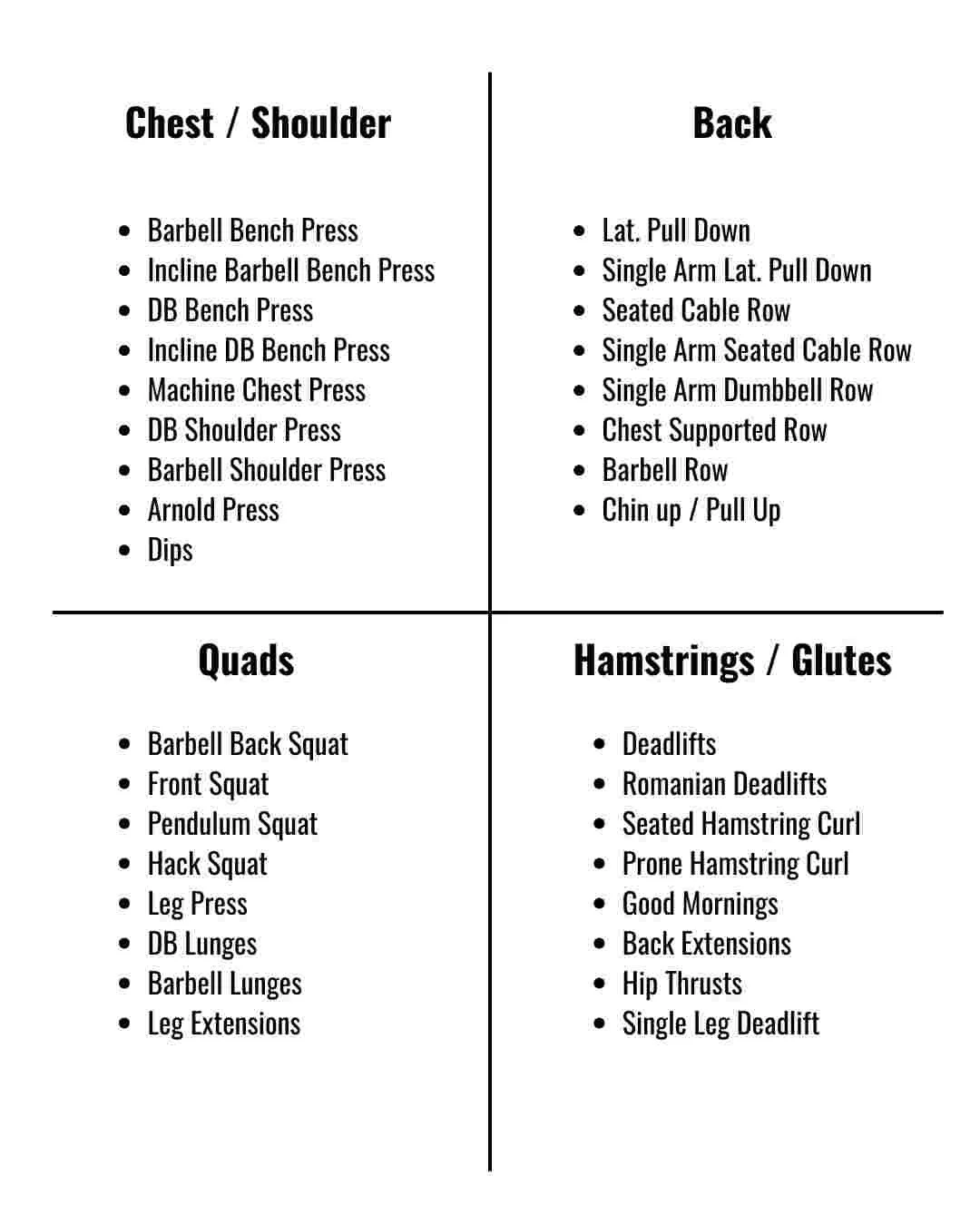
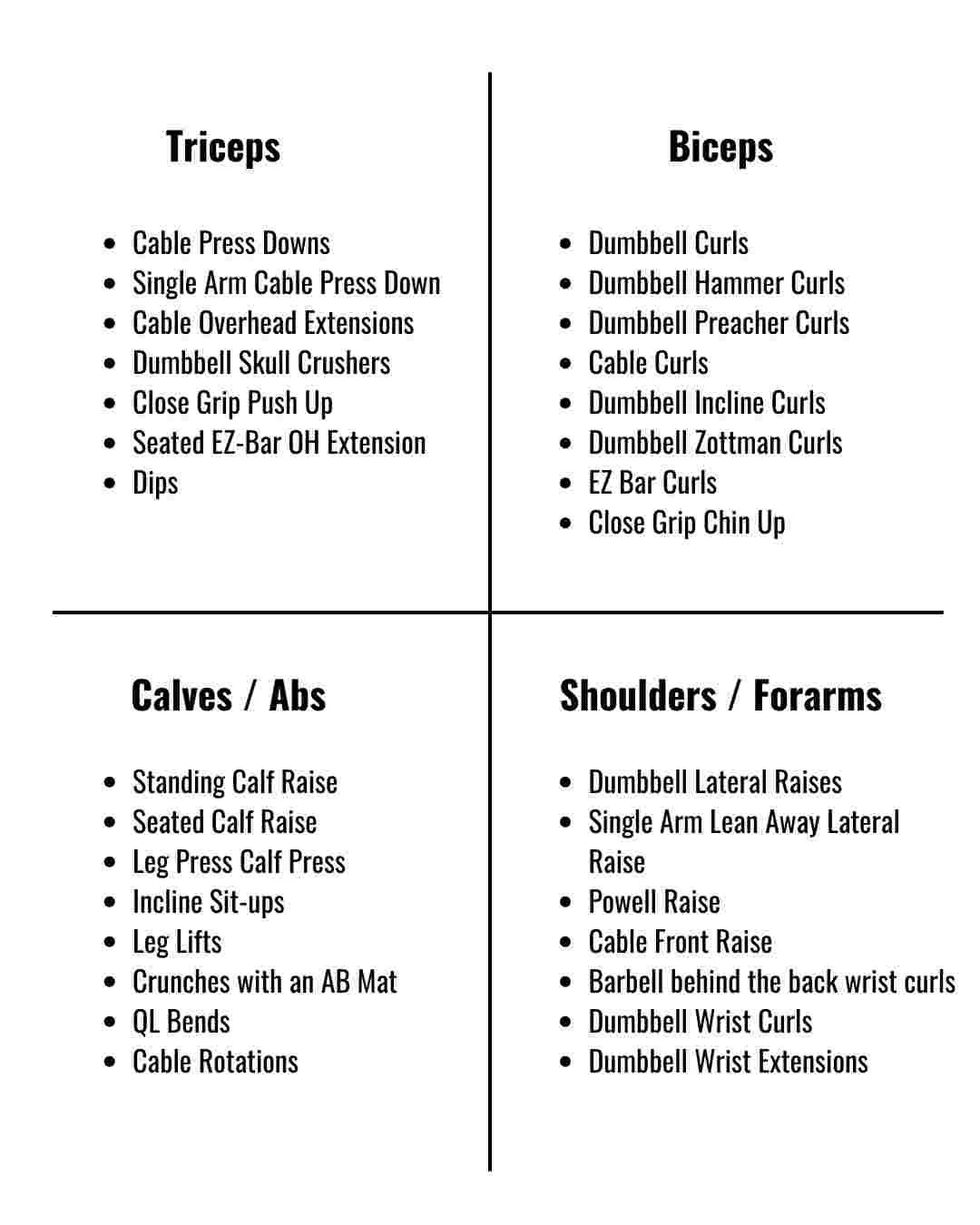
Sets, Reps and choosing weights
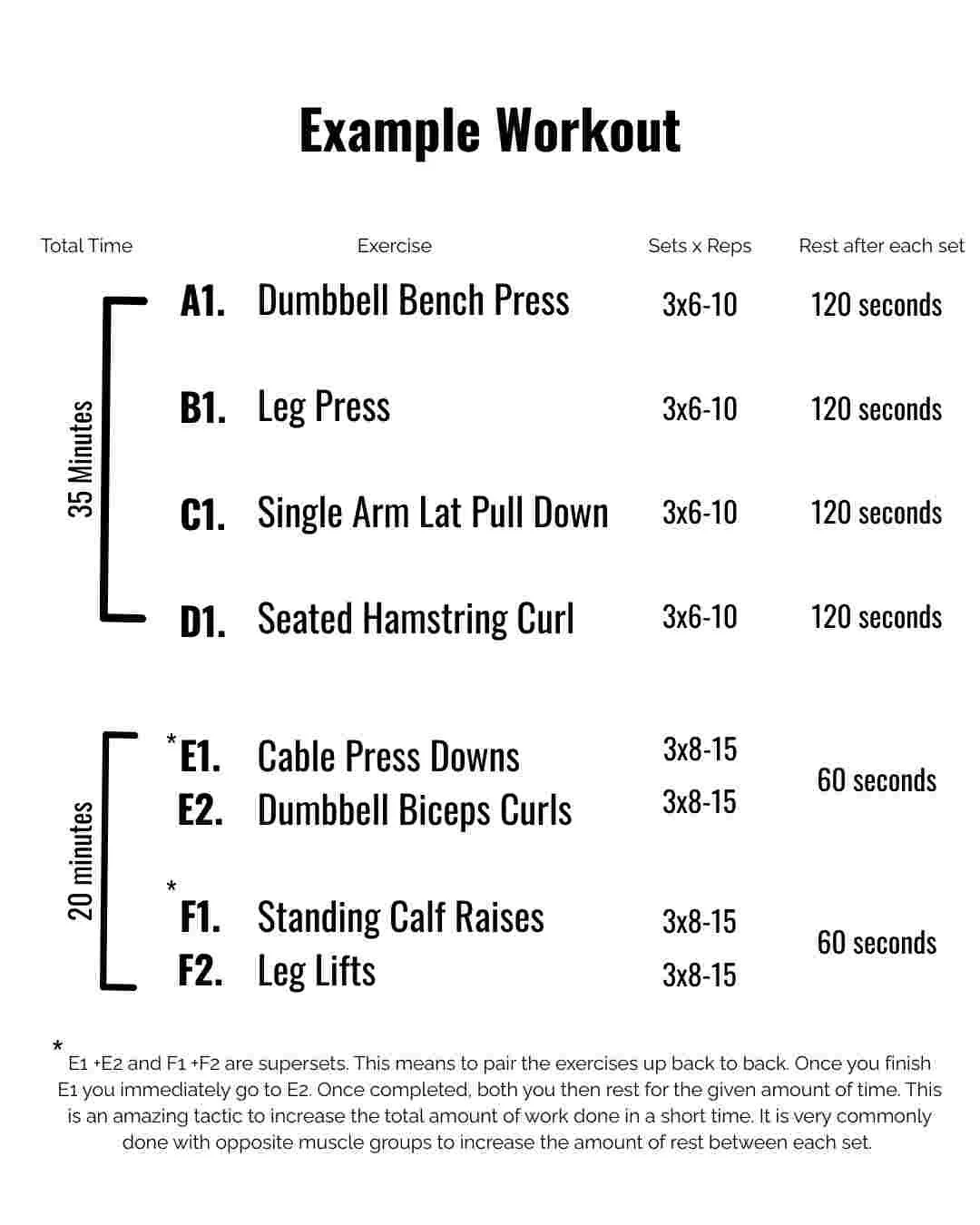
When it comes to sets and reps with the main 4 exercises, focusing on 3 sets of 6-10 reps will be the best for muscle growth and strength. Once you have been going to the gym for 6 months to a year, then upping the sets to 4 will help break through any plateaus.
The biggest question we always get is “How do I choose my weight?”. If you pick up the weight and get to 10 reps and can do more than 10, say 12, 13, 15, etc. The weight is too light. I would then go up 5 pounds and repeat the process.
I advise not going up in weight until you can do all three sets for 10 reps. Once you can complete all three sets for 10 reps, then up the weight once again.
Below is a nice example workout of how it might look on paper.
4. Nutrition is easy when you focus on what you can eat and not what you can't
The biggest thing fad diets don’t address is that they take food away from you. This is not sustainable. Okay, awesome, you made it to your goal weight. Are you still never going to eat a carb again? No cake on your own birthday?
The best approach that works for our clients is building a list of all the food you can eat. If you can stick to it 90% of the time, you will find success.
Pro tip: find 7-21 different meal combos that you can repeat over and over again. Below is a handy dandy generator that can help you accelerate that process.
5. Calories in vs calories out always wins
When it comes to losing, gaining, and maintaining weight, it comes down to calories in vs out. I focus this next bit on losing body fat specifically. To lose body fat, you NEED to intake less calories than you burn. Eating 500 calories under what it takes to maintain will lead you to lose 1 lb a week. Pretty good if you ask me, 52 pounds a year, and if 4-5 years, you will just vanish from thin air. (HAHA, just kidding, that will not happen). Your body does a great job of adapting to your new body weight, and it will cause you to have to readjust your calories. In due time. That’s a whole other topic.
Below is a calorie calculator for your own reference point.
6. Eating 1g per pound of body weight accelerates muscle gain
Whether you are trying to lose weight or gain muscle, eating proper protein is very important. Protein stems from the Greek word “proteios,” which means primary or foremost. Keeping your meals protein-focused will allow you to hit this goal easily and will leave you more full throughout the day. Protein is also the building block of muscle. If you don’t eat enough (minimum of .8g per lb of body weight), you can find yourself spinning your wheels. Where you find yourself not seeing the strength gains or muscle tone you want.
An easy generalization is to eat your body weight in protein. This can be tricky for some individuals. If your protein goal seems to be unrealistic, just eat your height in Centimeters. For example: 5 ft × 12 in = 60 in. 60 in x 2.54 = 152.4 cm or grams of protein in a day!
Bonus Tip: Cardio doesn’t burn as much fat as you think and slows your metabolism to offset the increased energy needs.
The age of the only way to burn fat was to run yourself into the ground. Doing cardio/walking for hours a day is dead, and let’s be honest, so few of us have time for that. On top of it, when you do lose all the fat, your body will still lack definition and tone due to the lack of muscle. More recently, studies have even shown that the more you walk, the less effective the walking is at burning calories.* Your body self-regulates and burns less energy at rest, knowing you will be doing more walking stints. On the other hand, when you build more muscle, your body will burn more calories at rest.
*Knaan, T., Ziv-Av, E., Dubnov-Raz, G., Markus, I., Peled, D., Manich, P., Barazany, D., Ramati, M., Aziel, G., Luxenburg, C., Levy, C., Melanson, E. L., & Gepner, Y. (2026). Multilevel metabolic adaptation to exercise training. Communications medicine, 6(1), 244. https://doi.org/10.1038/s43856-026-01502-z